
If you are seeking new home insurance, you may encounter difficulties if your aluminum wiring uses purple wire nuts. While these connectors are approved by Underwriters Laboratory and accepted in the NEC, most insurance companies in Florida do not accept them. The preferred remediation methods are Alumiconn or Copalum connectors. Even Citizens Insurance, often considered the carrier of last resort, does not accept purple wire nuts.
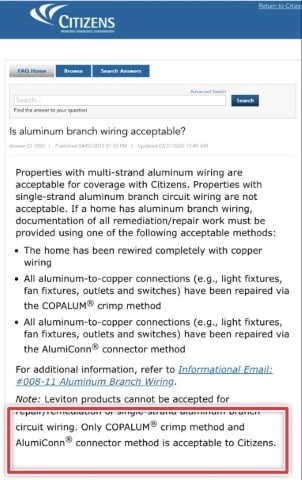
Why insurance companies have issues with purple wire nuts
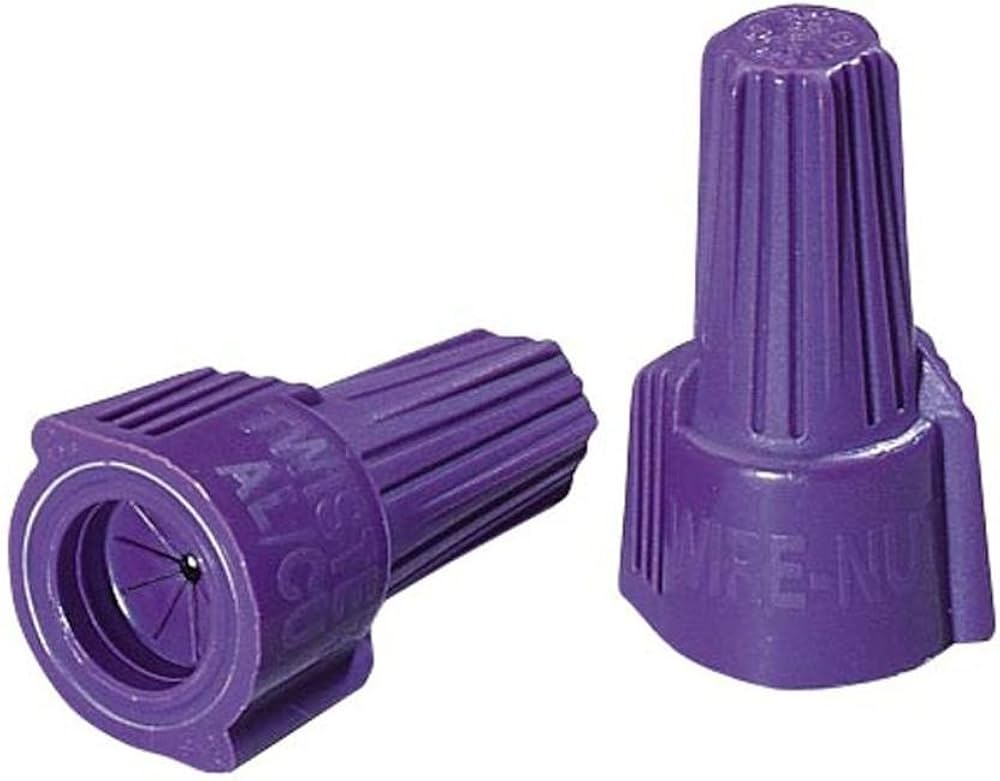
Ideal #65’s have a high failure rate, which is why insurance companies often avoid them. Their design does not separate copper and aluminum wires, unlike other connectors. Because copper and aluminum expand at different rates when heated, this can increase resistance. High resistance generates heat and may lead to fire. Since their release, independent studies have evaluated their use for remediation.
PIGTAILING USING IDEAL #65 “TWISTER” CONNECTOR
After about 1987, when UL adopted a revised standard (UL486C) applicable to twist-on connectors for aluminum wire, twist-on connectors were no longer being marked (in the USA) as UL listed for aluminum wire applications. In 1995, UL accepted a twist-on connector – the Ideal #65 “Twister” – for aluminum-to-copper wire combinations, including those commonly used in the “pigtailing” retrofit. The Ideal #65 has been heavily promoted for that application. The connector is essentially the same as twist-on connectors that had performed poorly in previous testing, the major difference being that it is prefilled with inhibitor compound. Based on its construction, there is good reason to question the long-term performance of the Ideal #65. Because of its UL listing, however, most electrical inspectors would accept this connector for pigtailing of aluminum wiring.
As soon as it appeared on the market, the Consumer Product Safety Commission (CPSC) questioned UL’s listing of this connector for the aluminum wire pigtailing wire combinations. Although the manufacturer claims that the connector has been thoroughly tested for the application, neither the manufacturer or UL have released any substantive test data. The manufacturer states that the connector has received CSA certification for the same wire combinations. Information developed so far indicates the following:– The manufacturer is no longer claiming that the connector is intended for use in the pigtailing retrofit application. Instead, the manufacturer now states (to CPSC) that the Ideal #65 is intended for such applications as connecting lighting fixtures and ceiling fans. Ideal has committed to CPSC to change its advertising and instructional information accordingly.
– UL did not independently perform the “heat-cycle” life tests required by their standard. These tests were performed by the manufacturer, with UL accepting the manufacturer\’s results.
– The connector was not “heat-cycle” tested for the common pigtailing wire combinations with current passing through the aluminum-aluminum wire path
(in an aluminum-aluminum-copper splice).– The “heat-cycle” tests that were performed by the manufacturer on the Ideal #65 “Twister” connector were not done using aluminum wire of the type actually installed in homes built in the 1960’s and early 1970’s.
– The CSA certification was based on UL\’s acceptance for listing. CSA did not independently evaluate the Ideal #65 connector. In fact, the use of a zinc-plated steel spring in the connector violates a CSA general requirement for connectors for aluminum wiring. CSA is re-evaluating the certification of this connector and may now do its own testing.
– Both the plastic insulator of the connection and the inhibitor compound inside the connector ignite readily and burn freely. This increases the chance of fire ignition if connection failure occurs.
Independent testing of the Ideal #65 “Twister” has demonstrated the following:
– Installed according to the manufacturer’s instructions (without abrasion or pretwisting), the connector does not reliably establish low-resistance connections. (This finding contradicts the manufacturer’s claim that particles in the inhibitor inside the connector serve to abrade the wire and eliminate the need for separate abrasion of the wires.)
– The Ideal #65 connector does not consistently pass the UL “heat-cycle” test requirement when tested with aluminum wire of the type actually installed in homes with current passing through the aluminum-aluminum path in a pigtailing (aluminum-aluminum-copper) splice.
– The performance of the Ideal #65 Twister is essentially the same as that of poorly-performing twist-on connectors previously evaluated for the aluminum wire pigtailing application.
Approved methods for aluminum wiring remediation
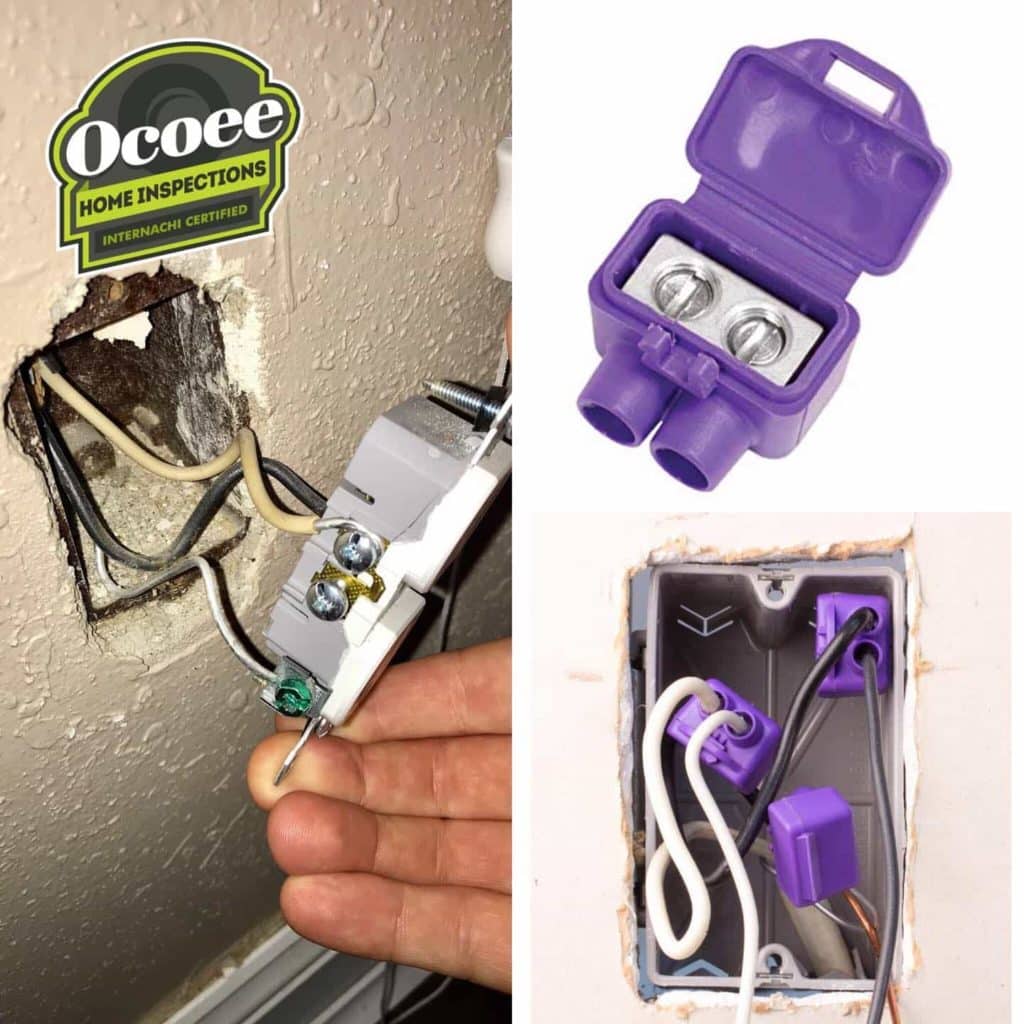
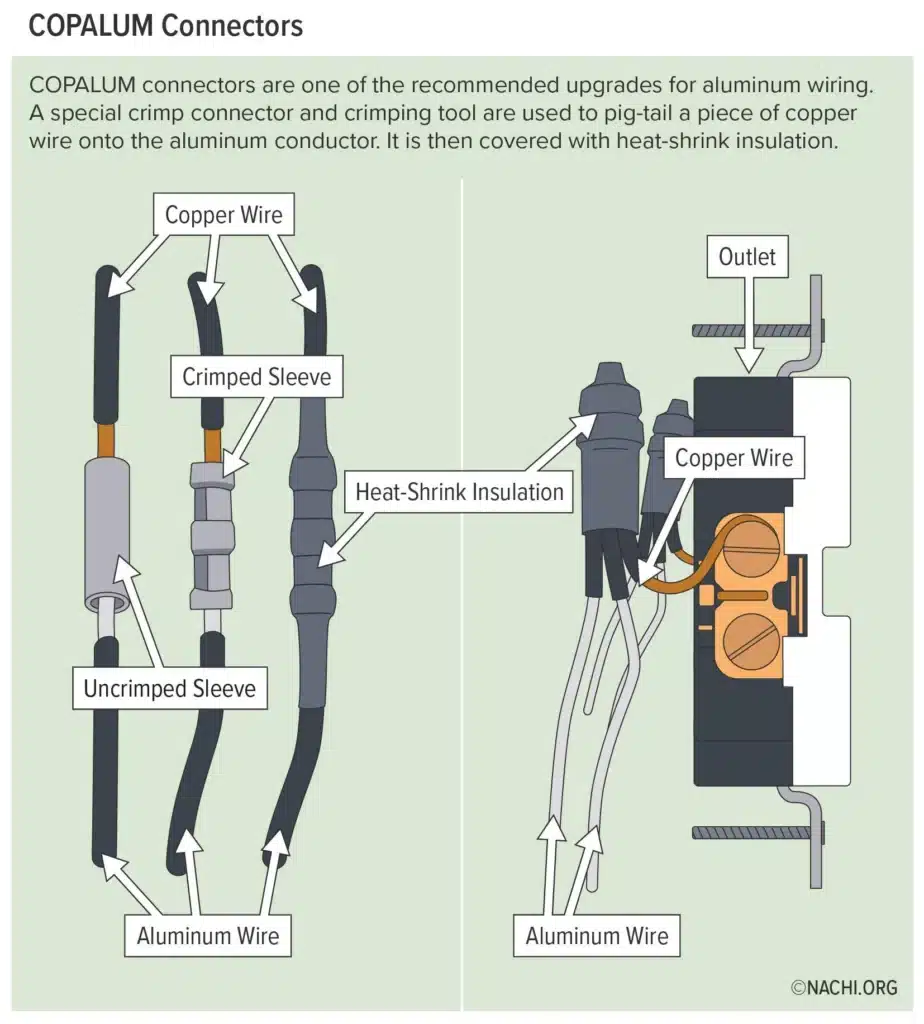
If your home has single-strand aluminum wiring, you might need to have remediation work done to qualify for homeowner’s insurance. The only approved connectors are Alumiconn and Copalum. An electrician will need to install these at every outlet and light fixture. Because Alumiconn connectors are larger, the electrician may also need to put in bigger junction boxes for the outlets. Alumiconn connectors cost about $3 to $4 each when bought in bulk. Each outlet needs three connectors—one for hot, one for neutral, and one for ground—so the total cost can add up quickly, especially in larger homes.
If your home has older aluminum wiring and you would like to have it inspected be sure to call us at 407-633-1661 or book online.