

This is part 5 of our 7-part series that explains the roof geometry section of the wind mitigation form. In this section, we focus on the roof shape.
Roof Shape
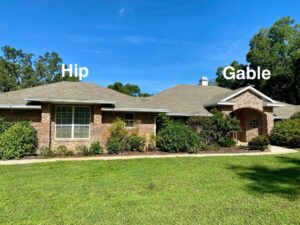
For this article, we’ll focus on residential homes. That means we won’t cover option B, which applies to flat roofs on large commercial or multi-family buildings. Almost all homeowners only need to look at option A or option C on the form. If your house has a “Hip” roof, you’ll select option A and get a good insurance discount. If you have to choose option C, your house doesn’t qualify for the discount.
What are the requirements for a roof to qualify for the Hip discount?
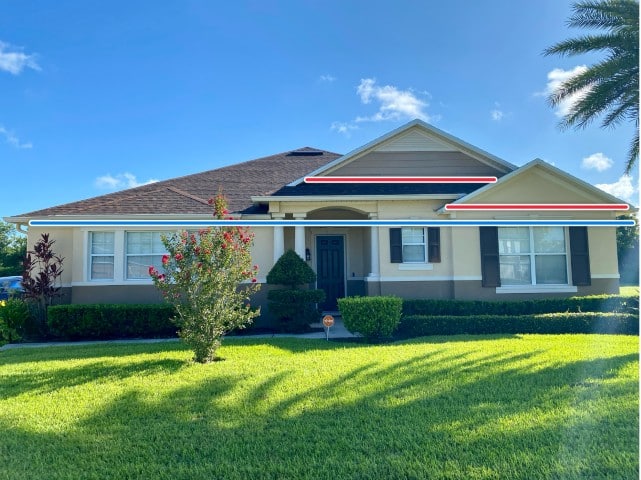
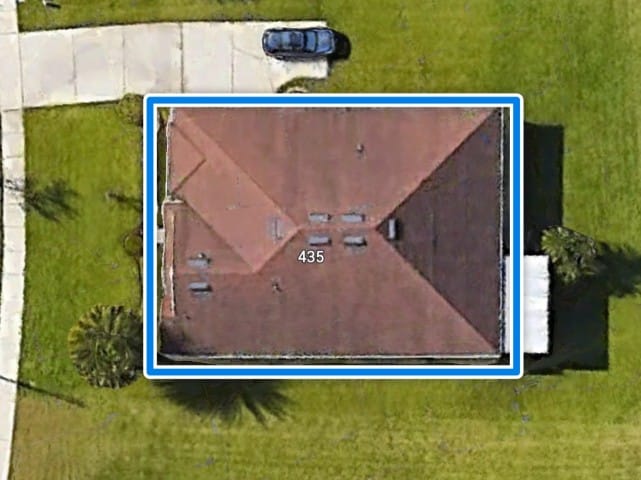
According to the wind mitigation form, a roof is considered a Hip roof if other shapes make up no more than 10% of the roof’s perimeter. For example, if your roof’s perimeter is 300 feet, only 29 feet or less can be non-hip features, such as gables or flat sections. The photos below highlight the roof perimeter in blue and the non-hip features in red. Even though most of the roof is hip-shaped, the two front gables push it over the 10% limit allowed by the form.
Is this credit a big discount?
Each house and insurance company is unique, so the numbers can vary a lot. For instance, one of our clients in Orlando was quoted $11,000 per year without the discount and $4,000 per year with it. He needed to retrofit his straps to qualify for the discount, but it ended up saving him a lot. If we find straps that do not meet the requirements during a home inspection, we always let our clients know. While this is not technically a defect, it could make the insurance too expensive for some people.
To book a wind mitigation inspection call us at 407-633-1661 or book online with our online scheduling system.